

Review: Dell’s XPS 15 7590 reaches for 8 cores of CPU power - dubreuilnortur41
Dingle's XPS 15 (version 7590) is a test of just how much hardware you can jam into a 4.2-hammering laptop. This latest loop includes up to an 8-core "overclockable" Core group i9-9980HK and a separate GeForce GTX 1650 card. That is a lot of heated up hardware in a body arguably non built to handle it. Computer hardware you'd expect to see in a gaming laptop, not a top-end, thin-and-frivolous workhorse.
We know why Dingle prospective did it: to compete with another high-end 15-inch laptop computer that's stuffed to the gills, the MacBook Affirmative 15. That's not a gaming machine either—both are systems designed for programmers, engineers, content creators, and other calculation-intensive professionals. But the sad truth is most consumers will compare the pass CPUs in both laptops, and bargain the unrivaled with the "quicker" C.P.U.. So yes, if Malus pumila is sledding to cross the note with a Core i9, Dingle is apparently ready to cross it overly, thermic limitations be blasted. Our review volition see if the XPS 15's adulterate was worth the sacrifice.
 Gordon Mah Ung
 The XPS 15 7590 has been everyone's go-to 15-in powerhouse laptop for years, but is this the finally stop?
What's outdoorsy: Same as before
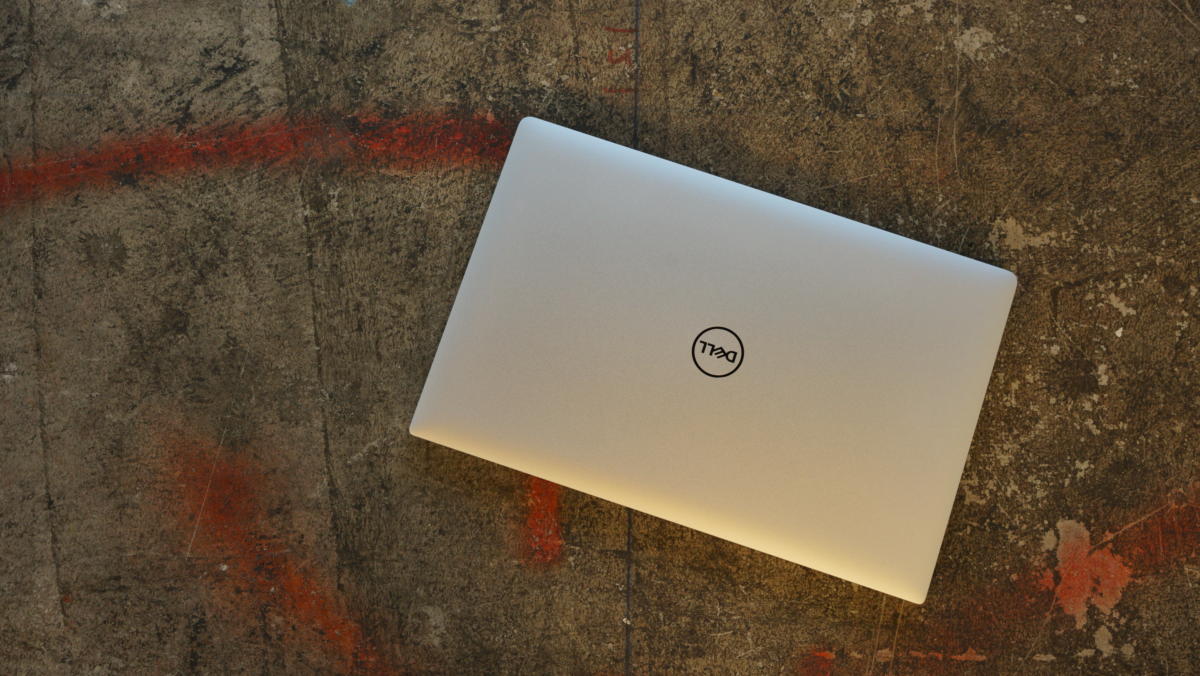
First, we'll start off in the most unremarkable surface area: the exterior, essentially the same every bit before, with a carbon fiber keyboard deck, aluminum top and aluminum bottom. Most probably could non tell the difference betwixt old and new except for the relocation of the webcam from the bottom to the top of the screen. So yes, repeat-chin folks, joy.
The biggest change is the processor. While the previous XPS 15 9570 featured an 8th-gen 6-core Core i7, with an optional 6-effect Core i9, the newest XPS 15 offers Intel's newest 9th-gen 8-core Core i9—and non just any 8-core C.P.U. either, simply the overclockable Core i9-9980HK.
Graphics bumps upward, to a fault. The previous overstep GPU was a GeForce GTX 1050 made-up on the Pascal architecture. The XPS 15 7590 maxes out with a GeForce GTX 1650 built on the newer Turing architecture.
The eternal rest of the specs of our revaluation sit turn the dial to 11 equally well—bigger, faster, fancier. Here are the inside information:
XPS 15 7590 Specs:
CPU: Intel 9th-gen Core group i9-9980HK
RAM: 32GB DDR4/2666
Video display: 15.6-inch 4K OLED @ 60Hz
GPU: GeForce GTX 1650
Computer storage: 1GB Samsung NVMe M.2 SSD
Ports: 2 USB Type A, 1 Thunderbolt 3 (4 lane), HDMI 2.0, Analog headphone, SD Card, Noble lock port
Size: 14.06 x 9.7 x 0.45-0.66 inches
Exercising weight: 4.4 pounds
 Gordon Mah Ung
 The left side of the XPS 15 features a barrel charger plug, USB Type A, HDMI 2.0, Bolt 3 and analog port.
Climb options
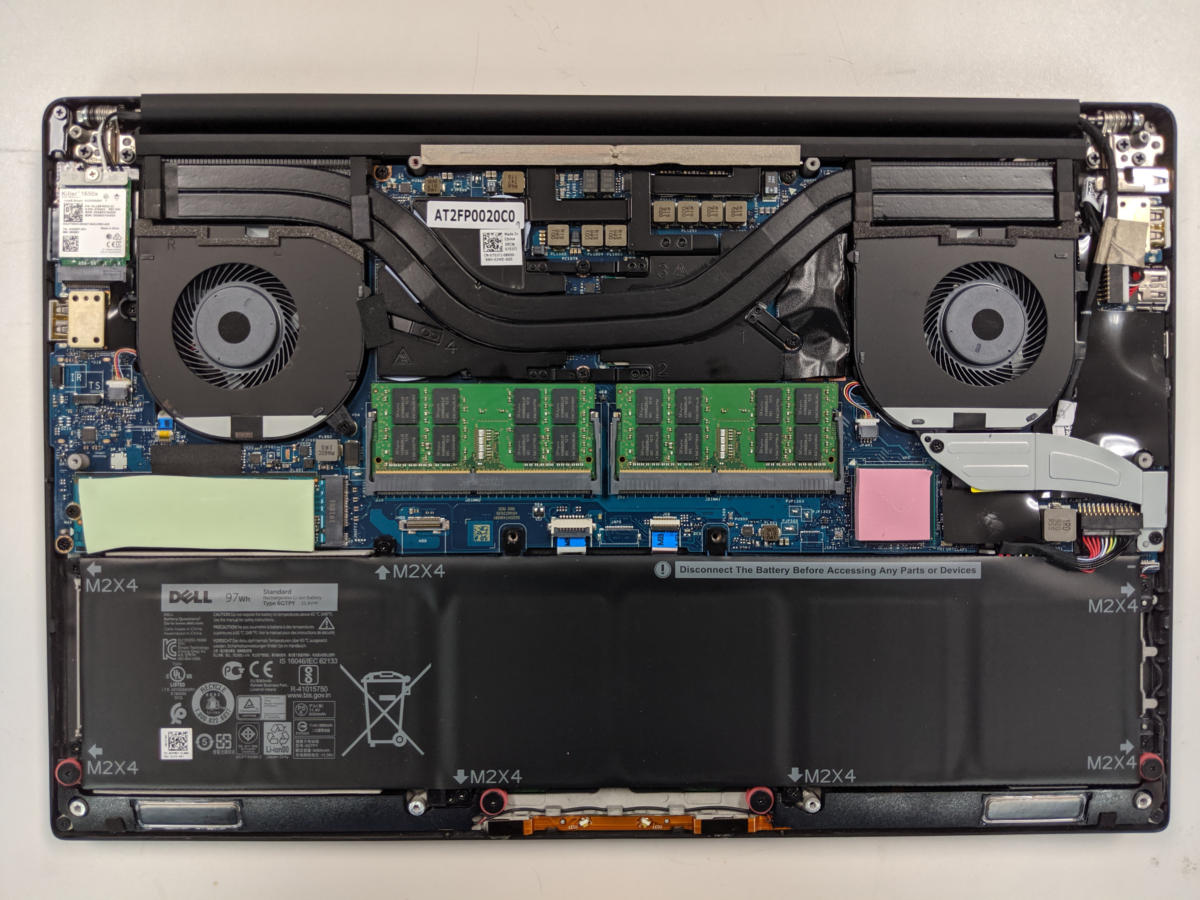
The XPS 15 continues to be friendly to upgrades. To let inside, you'll involve to murder the border Torx screws and two Phillips-school principal screws in the center. You tin can then gently remove the bottom board and get at 2 DIMM slots, an M.2, the battery, and a radiocommunication module.
 Gordon Mah Ung
 The XPS 15 7590 looks kindred to the former model. It's a snap to swap KO'd the M.2 SSD or the two Ram down modules. The battery is easily replaced as well.
Dell XPS 15 7590 Central processor Performance
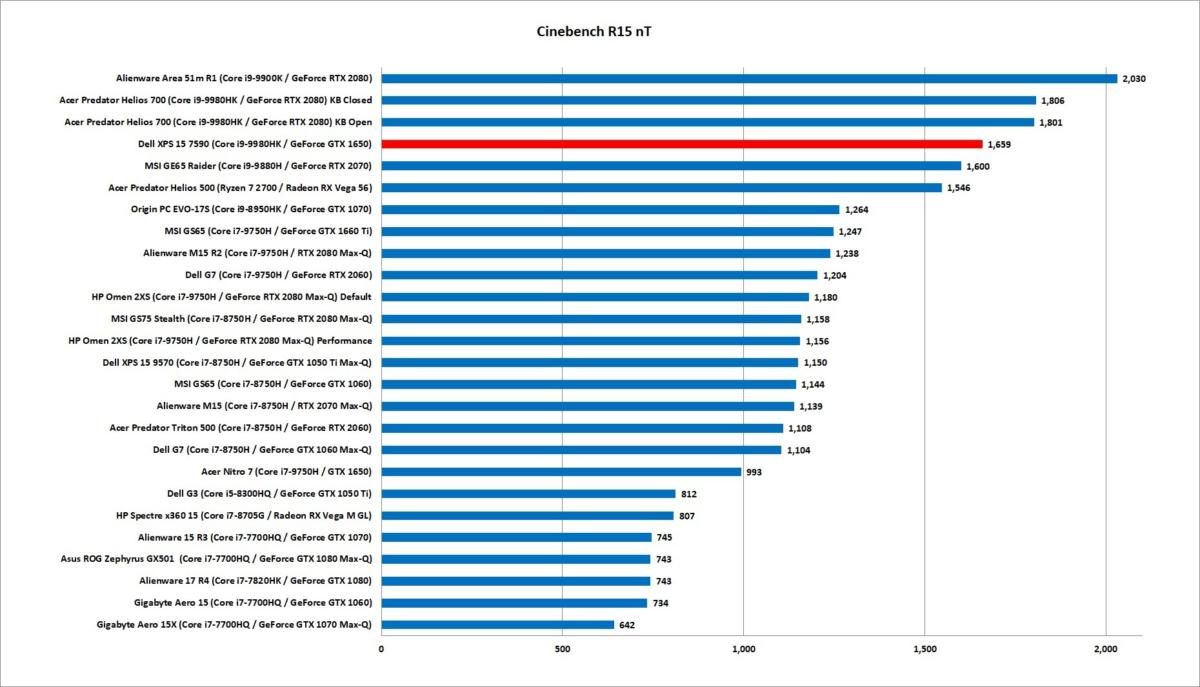
Our first benchmark is the venerable Cinebench R15. This is a 3D modelling test made-up on an locomotive sold by Maxon in its Cinema4D cartesian product. It is well-nigh a pure Central processor try and, like most visualization applications, IT loves CPU cores and threads.
The carrying into action of the XPS 15 7590 in the multithreaded version of this test is simply outstanding. Our results let in performance from triplet 9th-gen 8-core CPUs, nonnegative two screen background 8-inwardness CPUs (combined Intel, one AMD).
The Dingle XPS 15 7590 has enough ponies to outrun the thicker and heavier MSI GE65 Raider equally well Eastern Samoa the AMD Ryzen 2700-based laptop in this mental testing. It's outpaced only by the much larger and very much heavier Acer Predator Helios 700, and the beastly Alienware Surface area 51m R1.
 IDG
IDG The XPS 15's 8-core Central processing unit seems trump appropriate for bursty, short work.
Even though Cinebench isn't representative of every multi-threaded chores, IT's a pretty good viewpoint-in to bore performance in applications where Cinema4D is embedded, such as Premiere Inventive Cloud. If you have an older laptop, the uptick can represent significant: 45 percentage compared to the 6-core XPS 15 9570, and a quelling 123 percent faster than a 7th-gen Kaby Lake laptop.
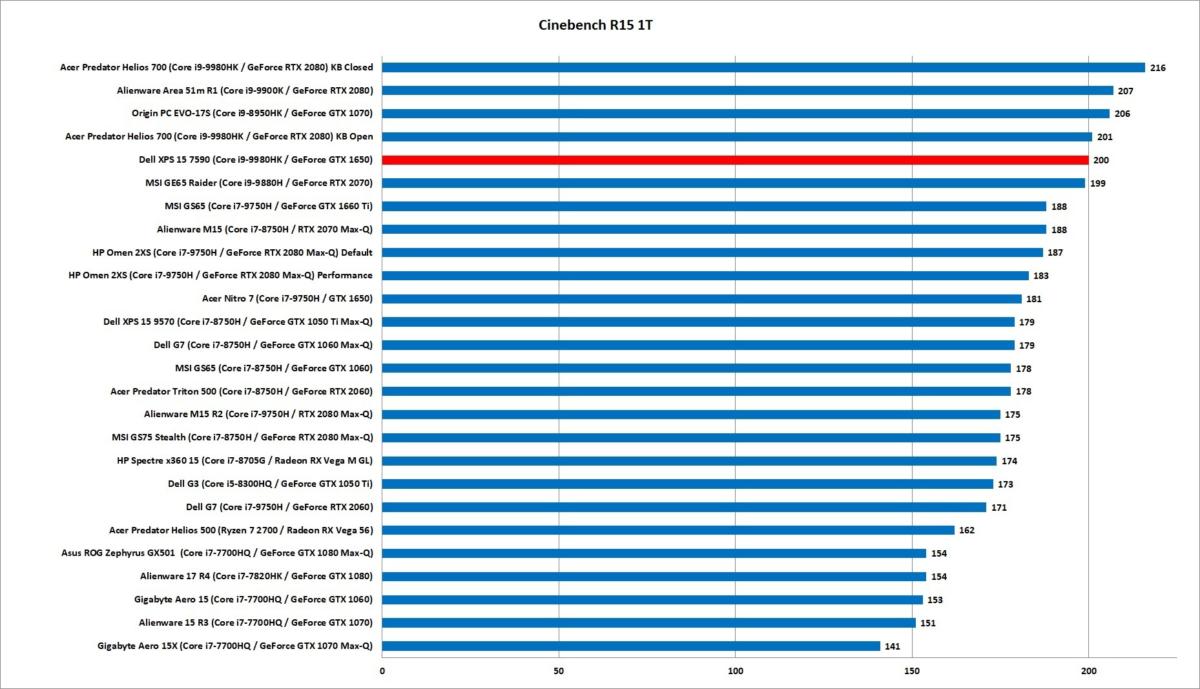
If all you really do is run Office and browse online, you very only care about widowed-threaded performance—and you probably don't need an 8-essence laptop computer, as you can undergo when we run Cinebench single-threaded. Again, 3D modelling is not representative of all application performance, but gives an idea of how the XPS 15 volition respond under a fixed sui generis-threaded load.
The higher scores of the 9th-gen Gist i9 laptops are in that respect for all to see. Yet, you should also notice that the 9th-gen and 8th-gen Core i7 laptops follow enveloping behind. Most would be troubled to tell the difference betwixt a Core i9 or Core i7 in the immense legal age of single-rib tasks much as Bureau, Chrome or even most Adobe Photoshop routines, even if they are a gnomish quicker.
 IDG
IDG Although the 9th gen Core i9 systems all lead the pack, you'd be challenging-ironed to feel the conflict between most of these laptops in single-threaded tasks.
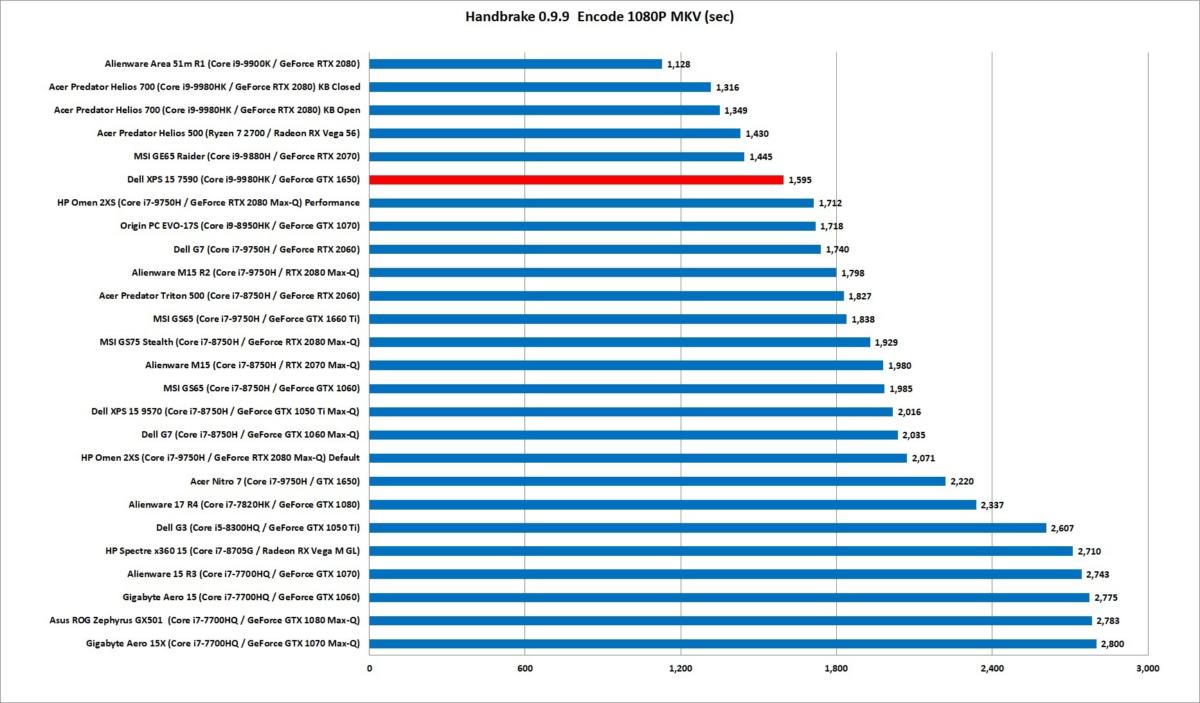
One issue with the benchmarks above is they run too rapidly (within a few proceedings) to hotness upbound the CPU much. That's why we use the free HandBrake utility to encode a 30GB file using the H.264 encoder. Even happening our 8-substance CPU laptops, the tax typically takes in excess of 25 minutes to finish. That warms ahead the CPU and should reveal some limitations in the cooling system or power delivery of a laptop computer.
It's Here that we see the XPS 15 7590 swap positions with the MSI GE65 Raider, which information technology beat in Cinebench R15. That thicker, heavier MSI GE65 can keep its CPU cooler and run it with power better than the light XPS 15 can. In fact, the MSI GE65 beats the XPS 15 plane though it uses one step down in CPU models.
The thermal limits on the XPS 15 7590 set out it uncomfortably close to the HP Omen 2XS (when the last mentioned is set to performance mode). We'll plunge further into the thermal limitations of the XPS 15 and what you should expect tardive on.
 IDG
IDG Our longer-running HandBrake test shows the limits of the XPS 15's cooling.
XPS 15 7590 Gaming Functioning
The HandBrake tests give you a good soupco or so what to have a bun in the oven if you try to game on the XPS 15. While it's not officially a gaming laptop computer, anyone sounding at its parts may understandably assume other. We won't run it through the full metal glove of play tests, just enough to show you what it can (and can't) do.
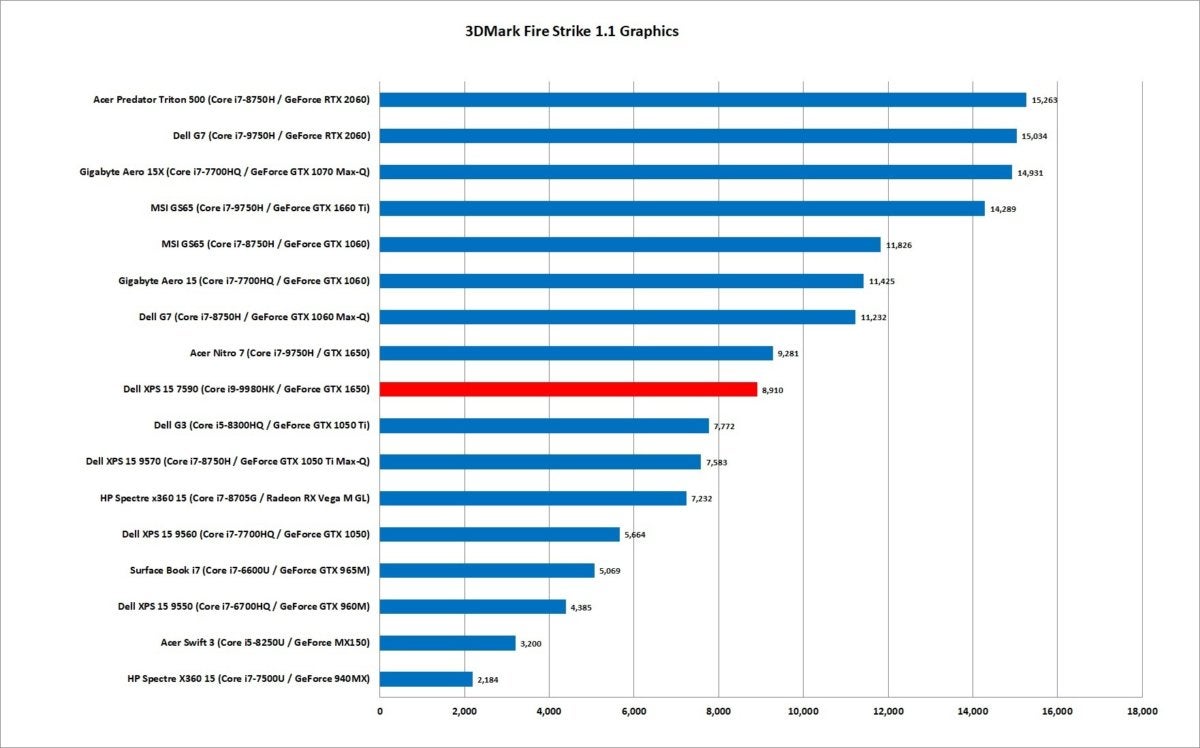
Prototypic ahead: We ran UL's 3DMark FireStrike to measuring stick just the graphics performance of the laptop in DirectX 11. The result is no surprise: The XPS 15 slides in just low an Acer Nitro 7 budget gaming laptop with the aforesaid GeForce GTX 1650.
 IDG
IDG The Dingle falls in merely behind an Acer laptop computer with the same GPU in it.
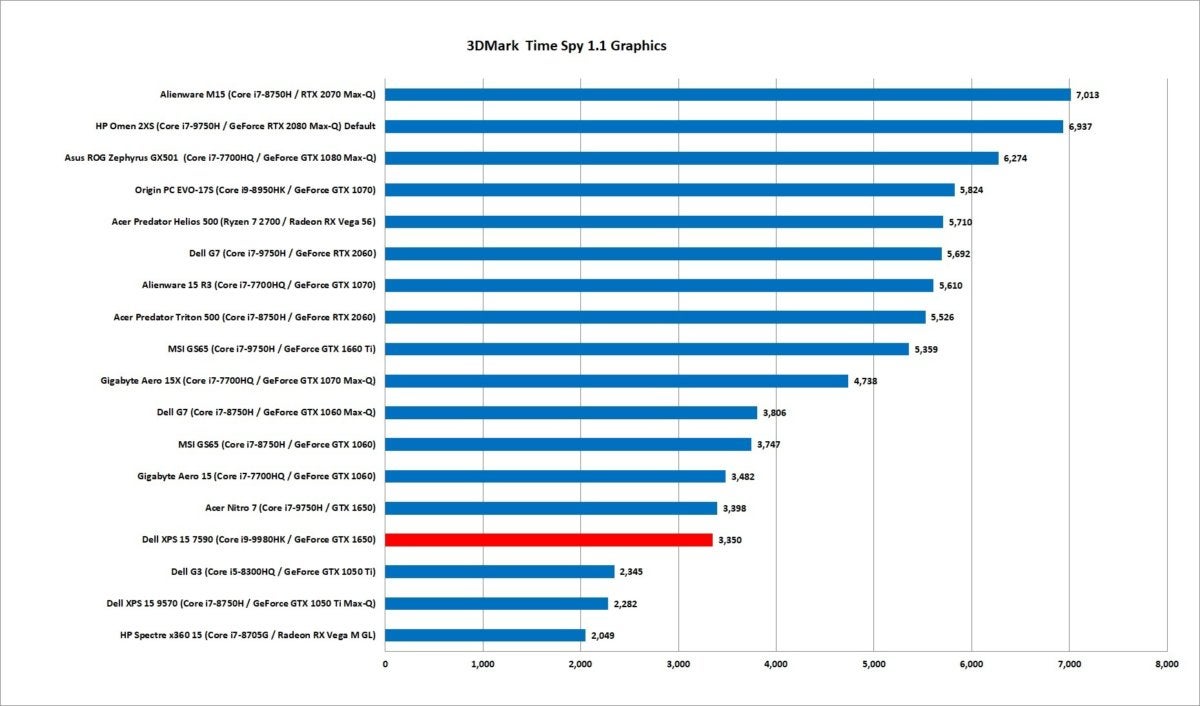
Moving connected to to DirectX 12 performance, we too premeditated the XPS 15's GPU using 3DMark Time Undercover agent, a newer test with far Thomas More complex graphics. In pure graphics performance, the XPS 15 7590 ties with the equivalent Acer Nitro 7 with the duplicate GPU. Happening paper, the XPS 15 7590 is the equal of more thermally challenged GeForce GTX 1060 GPUs.
 IDG
IDG In Time Spy, which is far many complex than FireStrike, it's dead on tied with slower GeForce GTX 1060 laptops.
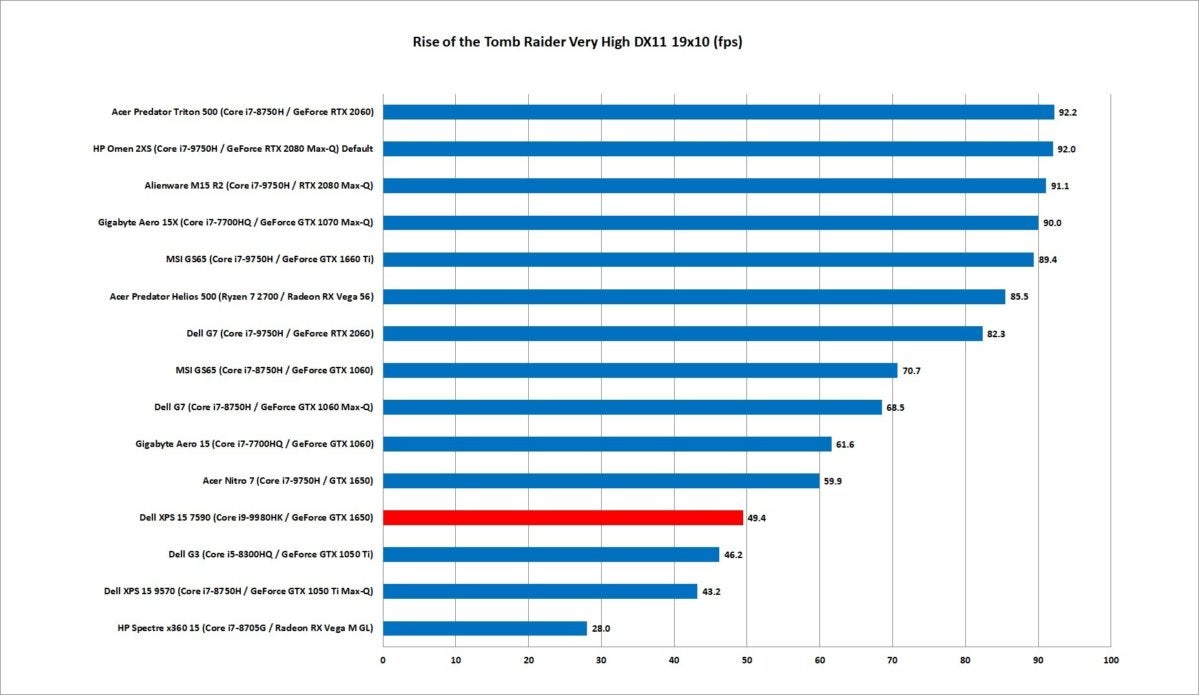
In Resurrect of the Tomb Raider, we can see the limits of the XPS 15's littler trunk. The spacious chassis of Acer's Nitro 7—and just about of the gambling laptops that make up this listing—helps keep IT comfortably in advance of the XPS 15.
 IDG
IDG The smaller XPS 15 7590 can't keep raised with the larger Acer Nitro 7 despite having the very GPU inside, and arguably a more than faster Processor.
Dingle XPS 15 7590 Battery Sprightliness
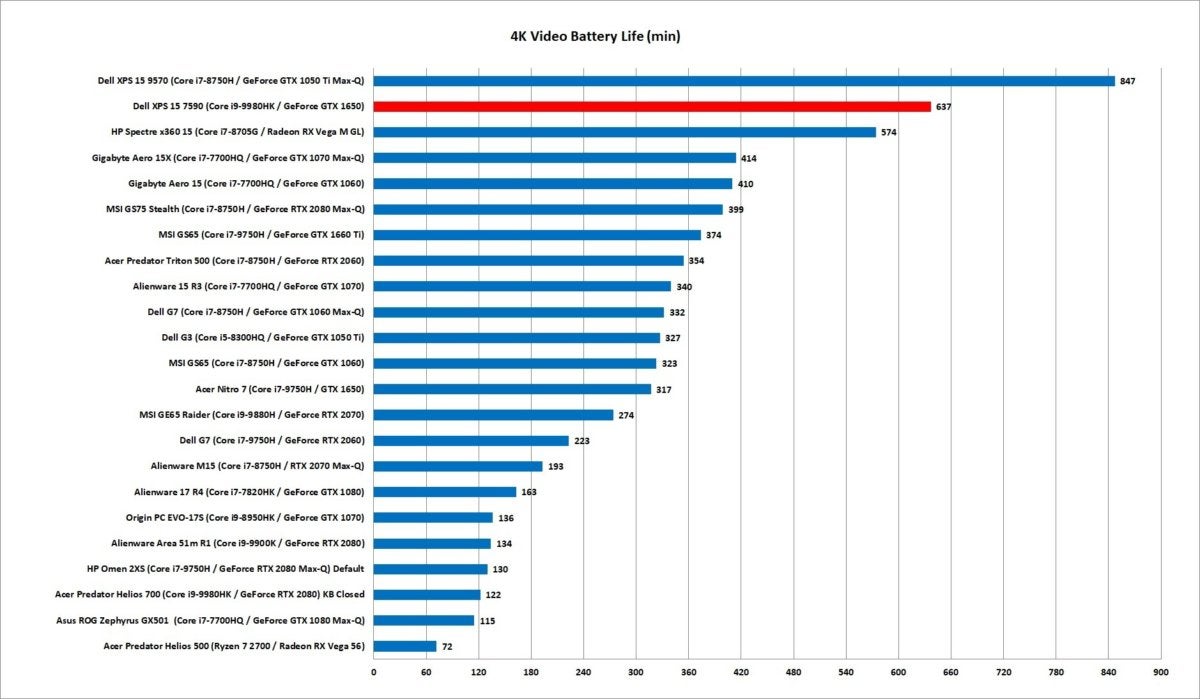
We'll end our official tests with the most important metric to many an: battery life. We loop a 4K picture with the laptop computer in airplane mode, with the screen brightness set to reasonably brilliantly 250 to 260 nits. We also attach a pair of earbuds with the audio turned on about center.
We honestly didn't expect much from the XPS 15 7590, because of its 4K screen. Higher-resolving power screens generally lop a third off of battery living. With its 32GB of RAM and the rest of its hardware, we didn't think the XPS 15 would compete at all.
 IDG
IDG Battery life on the XPS 15 is exceptional considering its 4K silver screen.
Rather we were pleasantly surprised to see more than 10 hours of run time from the XPS 15 7590. That's plainly prodigious for a 4K-equipped laptop. The OLED panel likely helped, because OLEDs don't use power for backlighting on black scenes. Information technology besides helps that the XPS 15 7590 rocks a giant 96-W-hour battery.
But Here's the circus tent laptop connected our list: the Dingle XPS 15 9570 with a standard 1080p screen, which hits 14 hours of run time. Thus yes, if you want maximum runtime, opt for a lower-res dialog box.
We should note that video rundown tests are easy for modern laptops. Expect, pronounce, WWW browse to reduced life aside a third gear or Thomas More. If you plan to edit telecasting on the go, cut it in half at least. If you intend to play games, don't ever expect more an hour Beaver State two of battery life on any laptop. Cranking up the blind brightness will kill battery life, besides. A always, your mileage whitethorn vary.
 Gordon Mah Ung
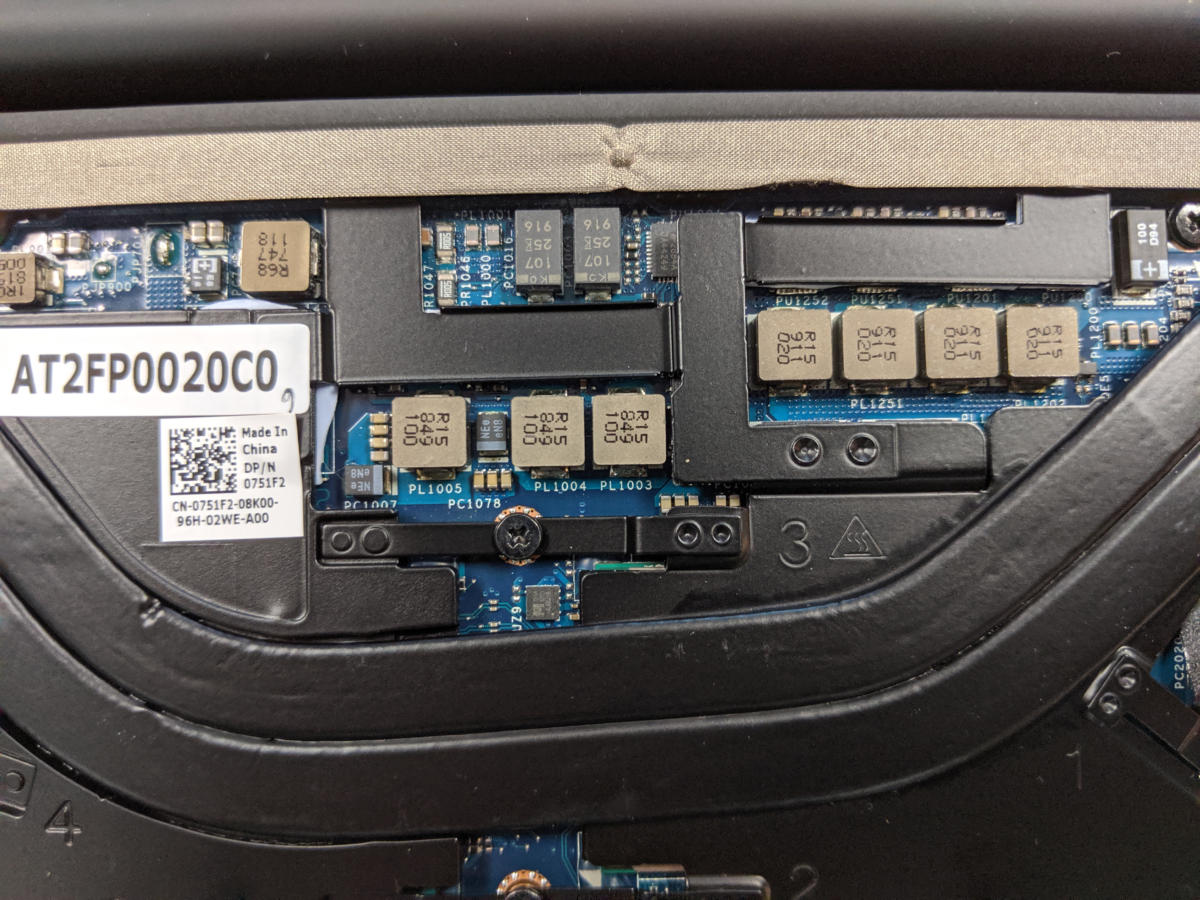
 You can go out the additional heat spreaders Dell has added to the XPS 15 7590's voltage regulators to help oneself trim overheating. Unfortunately, that's still asking a lot of the XPS 15 to push an 8-core CPU and 75-watt GPU.
Dell XPS 15 Thermal Throttling
We don't ordinarily generate into the weeds of the thermic performance of a laptop, only the XPS 15 7590 jams an 8-core CPU and properly powered GPU into a 4-impound, 6-ounce package. Is Dell asking overmuch of this slender chassis?
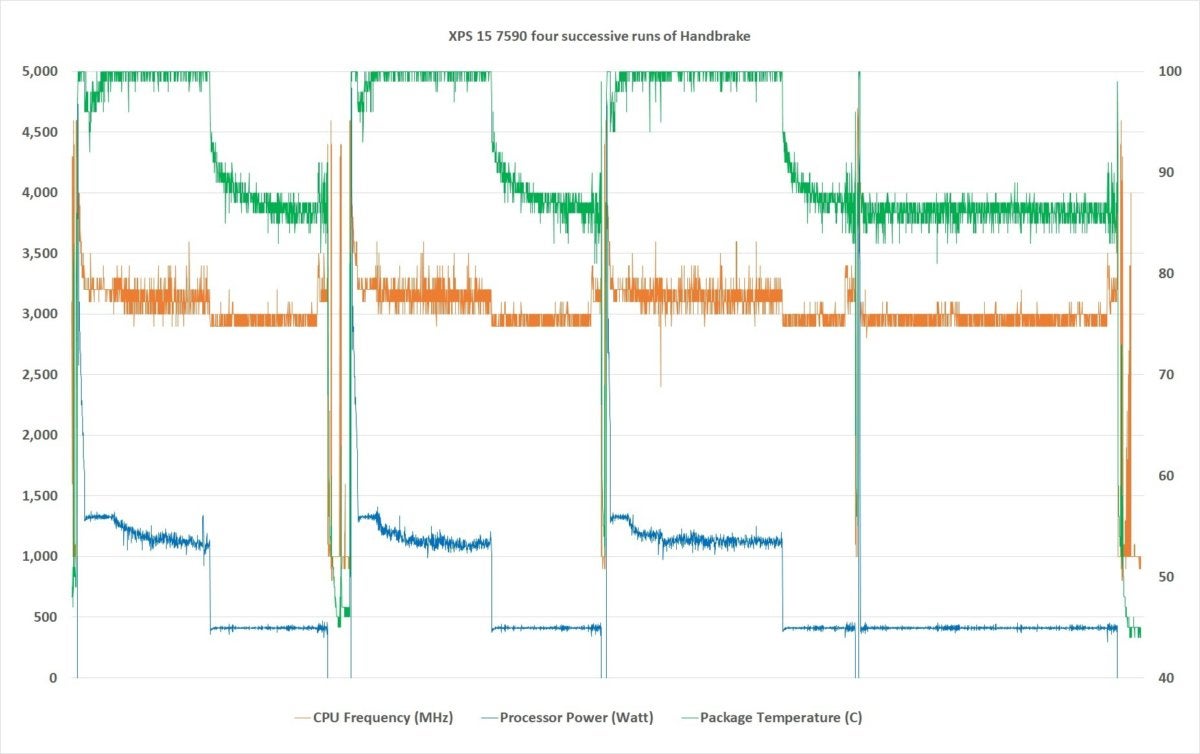
You belik saw a hint of the XPS 15 7590's thermal limitations above in our HandBrake test, where the XPS 15 loses to the thicker and heavier MSI GE65 Raider despite the Raider's "slower" CPU. To dig deeper, we conducted Little Jo runs of HandBrake back-to-back. That's in essence more than an hour of pegging the Mainframe at 100-percent use across all 8 cores.
We recorded the laptop's telemetry during the run. The green represents the CPU's temperature, the orange represents the clock speed, and the dingy represents the wattage of the scrap.
As you can picture in the graph below, the XPS 15 roars soured at 4.4GHz on all cores. But erst the laptop heats up, information technology begins to slow down. The time speeds surrender back to Earth, with virtually of the test running in the 3.3GHz roam. Eventually the laptop computer runs at its 45-W TDP valuation but still stays above its base clock of 2.3GHz.
For the ordinal and ordinal runs, you potty see the CPU's temperature is hotter for a longer geological period, but it hush up moves on. The fourth run has built up enough heat inside that most of the run is at 2.9GHz and a TDP military rank of 45 watts. There's also non much headroom unexpended for Turbo Boost on it last feed.
Frankly, this ISN't bad in the least when you consider that we're hammering whol 8 cores of a 4.2-pound laptop for more than an hour with clock speeds at reasonably high-pitched levels.
 IDG
IDG Information technology took quaternary successive runs of HandBrake, hammering all cores for more than 60 minutes, before the XPS 15 gave up ground.
Non all tasks are stormbound to the CPU. We also wanted to see what would happen to the XPS 15 when the GPU and CPU are some producing heat. You know, like in a game. For that we listed the C.P.U.'s vitals while playacting Player Unknown Battlegrounds. The game isn't legendary for its ripe graphics features, simply it is for its CPU loading, whether it's to cipher game physical science much as bullet drop or execute positional audio modelling, among other chores.
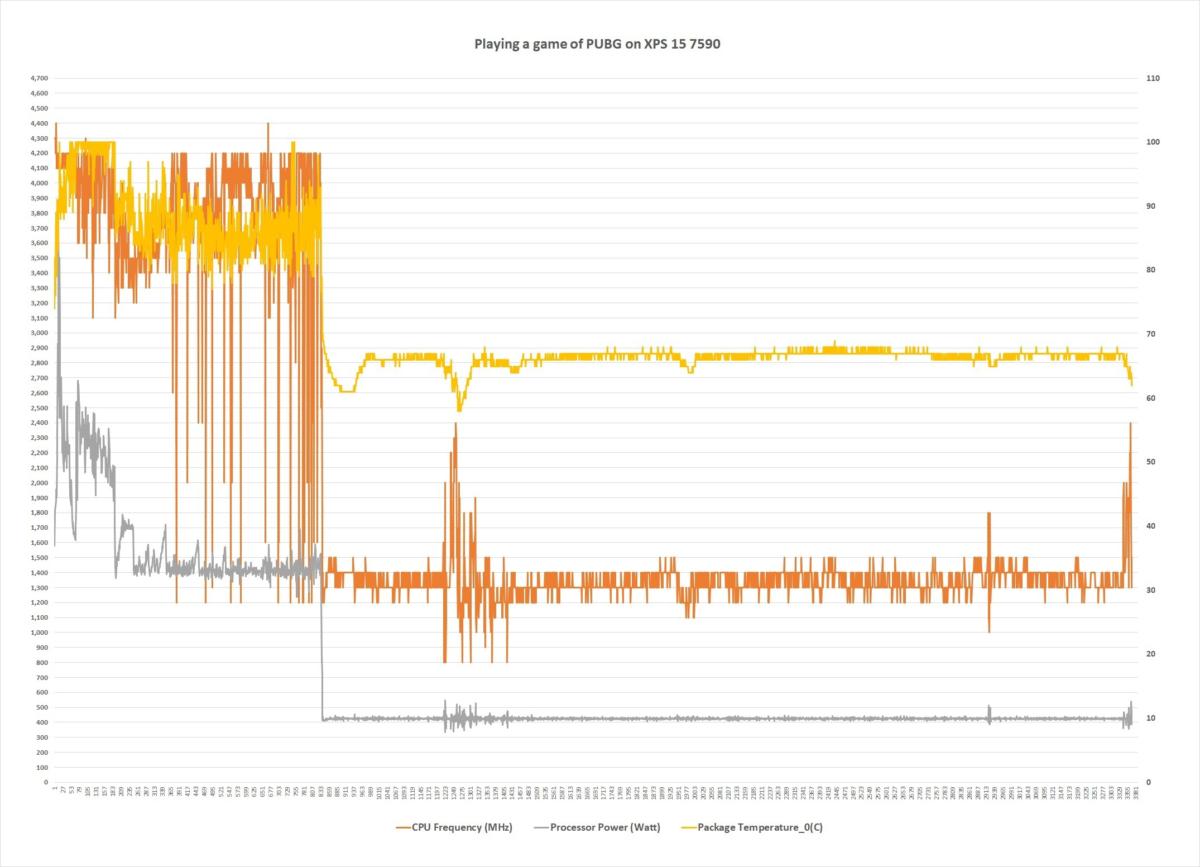
In the graph below, the orangeness is the CPU's clock speeds, the gray is the wattage of the CPU, and the fearful line is the CPU's temperature. We ran the game at 1080p with High settings, which is unity notch down from Ultra.
As you ass construe with, the time speed kicks along in the neighborhood of 4GHz for the first 15 minutes of the game. At that level, the Processor falls into the much lower gear of 1.4GHz for most of the game, with the CPU now in a low-world power state of 10 watts. Yes, we'll articulate that once again: 1.4GHz.
 IDG
IDG Performance dropoff on the Dingle XPS 15 give the axe represent a serious issue when you tax both the GPU and CPU simultaneously. Here you can construe with the clock speed of the CPU fall off a cliff about 15 proceedings into a game of PUBG.
This, frankly, is the issue that has pestered the XPS 15 series for some time: thermal and business leader delivery ceilings when all of the components are under loads. It's basically a 75-watt TDP GPU and a 45-watt TDP CPU (with boost taking it typically to 55 watts and higher) vying for cooling and business leader. Eventually you run out, and something gives.
One thing we alas don't have here is a frame value trace. Certainly frame rates dropped, but we suspect information technology's not the impact you'd assume active from, say, 2.6GHz to 1.6GHz. Given the GeForce GTX 1650's tame HP, a drop from 70 fps to 55 Federal Protective Service doesn't really change the experience much.
We suspect many an games could shoot this limitation (we likewise saw it on Rainbow Half a dozen Beleaguering). That perturbing vivid should make anyone with a gambling inclined consider the Alienware M15 M2 instead of the XPS 15.
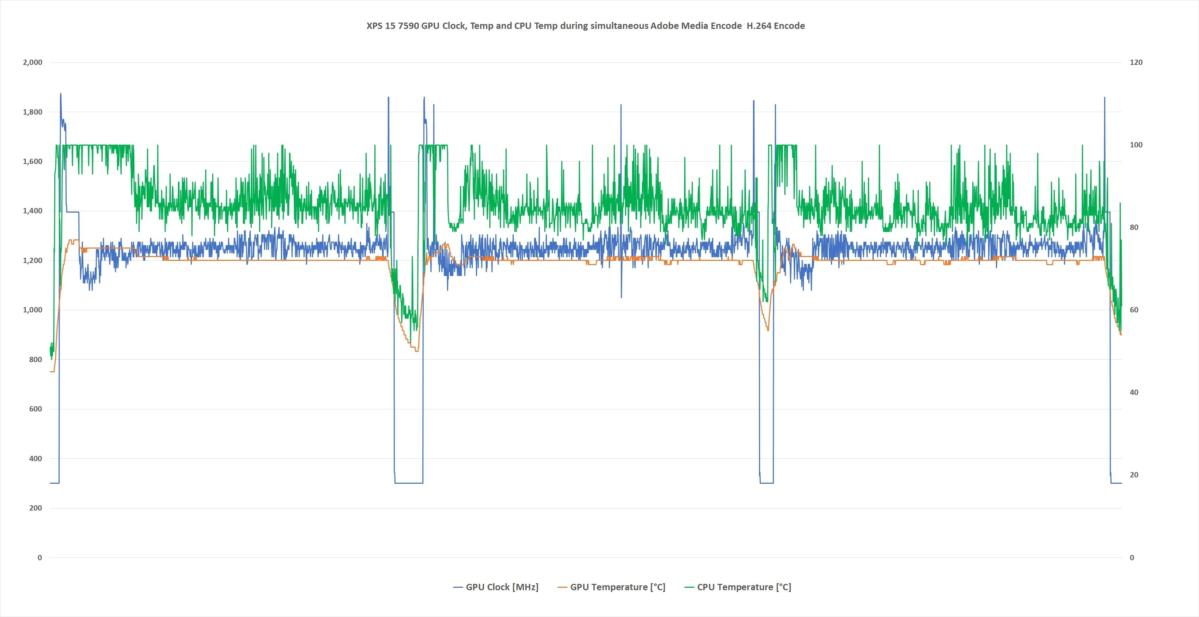
Of course, the XPS 15 7590 ISN't officially a gambling laptop. It's mostly witting for content creators and those who need a decent GPU and an 8-core CPU in a 4.4-pound package. To see if clockspeeds would collapse similarly while running a GPU- and CPU-intensive lotion, we installed Adobe Premiere Fictive Cloud and Adobe Media Encoder. We and so took a 4K TV project and had Media Encoder concurrently encode 15 duplicates of that project using the Mercury CUDA engine. Although it is a very heavy GPU laden, Media Encoder also taps the CPU.
We ran that project three times, with each run taking or so 15 transactions to complete. In the graph below, you can see that under the CUDA load, all was fine. The CPU's temperature is in green, the GPU's clock speed is in blue, and the GPU's temperature is in Orange. During 45 minutes of encoding 45 4K videos, we see no sagging of GPU clock low the load.
 IDG
IDG Running a burdensome CUDA workload on the GPU using Adobe brick Media Encoder, the GPU didn't crim.
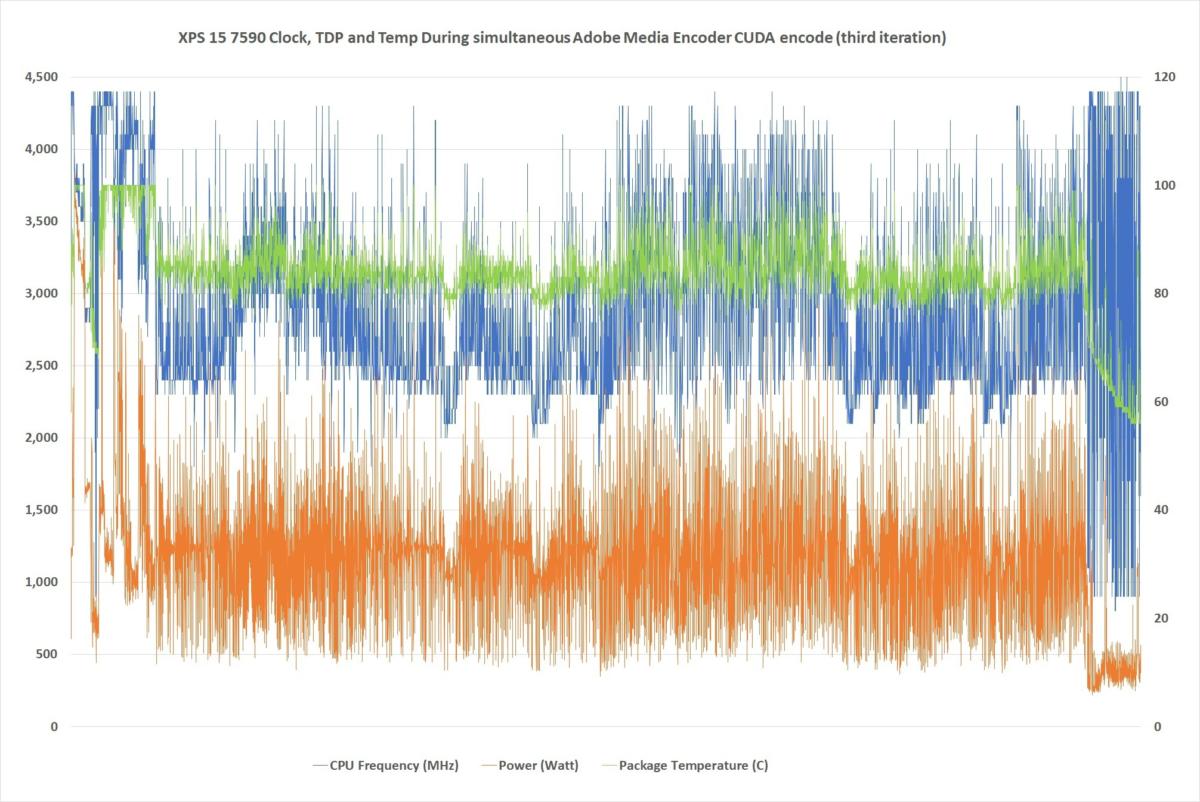
For the most recently run, we carved out the CPU's performance (the first two looked nearly identical). Because it's the third run, it'll also comprise the worst carrying into action for the CPU.
In the graphic down the stairs, the CPU clock speed is in blue, the wattage is in orange, and the CPU temperature is in green. For the most part, the CPU is moving at 2.9GHz to 3GHz. We're not sightedness the execution of the Processor doss to 1.4GHz, alike it did under a gaming load.
 IDG
IDG The CPU's clockspeed is represented in nonindulgent and for the most part, appears fine for this class of laptop.
We also ran the same workload under HEVC/H.265, which shifts nigh of the work from the CPU cores and GPU to the CPU's integrated graphics core. Adobe Media Encoder didn't allow United States of America to run HEVC encodes concurrently, so we ran 15 encodes in a quarrel. Even if you batch the load to Media Encoder with it determined to Mercury CUDA and Ironware, it appears to throw near of the mould to the dedicated encode/decode Quick Sync locomotive engine in Intel's integrated artwork chip. For the entire run, the CPU's graphics engine ran at its rated 1.2GHz, piece the GPU and CPU read a newspaper.
The stop storey is that while it's theoretically possible to crash the CPU clock speeds in depicted object creation, we didn't see IT under jolly heavy use cases.
Conclusion
The Dell XPS 15 7590 takes an newsworthy position among laptops. The top-end CPU and GPU options pronounce "gaming," and we've seen these parts scream—when installed in a 10.5-Syrian pound gaming laptop computer (13.5 pounds with the power brick.) Therein tiny undersize 4.2-lbf. Dell, though? No. But you're also not effortful approximately different barbells' worth of weight every time you need to get work done in the field.
The XPS 15 7590's thin-and-light chassis and easier weight are intelligibly in gear for embodied power users and creatives on the go. So while it's a trifle scary to see the clock speeds make off the cliff while gaming, the XPS 15 7590 aced the tests that more closely approximated actual usage cases.
So no more, in case you were questioning, don't buy the XPS 15 7590 as a gaming laptop. But if you'atomic number 75 shopping for a thin-and-undemanding workhorse (with compromises) you'll alike this Mary Leontyne Pric. Our unit with Kernel i9, 32GB of RAM, 1TB SSD and 4K OLED was selling for $2,649 at the time of our review. A likewise configured Macbook Pro 15 with the same Processor, also equally the same amount of storage and Drive, hits the wallet harder at $3,600.
Then yes, believe or not, the XPS 15 7590 is a deal. But know what you're buying and what you'rhenium buying it for.

Source: https://www.pcworld.com/article/398047/review-dells-xps-15-7590-reaches-for-8-cores-of-cpu-power.html
Posted by: dubreuilnortur41.blogspot.com
0 Response to "Review: Dell’s XPS 15 7590 reaches for 8 cores of CPU power - dubreuilnortur41"
Post a Comment